

Art Emergency
some sources of joy, as of late

The summer issue of The Panafold goes to print in a little over a week, so I’m deep in the “crunch time” stretch of my quarterly work cycle, which is equal parts stressful and exciting. Almost invariably during the month leading up to print, I find myself sleepless, preoccupied by the pieces that have yet to fall into place. There is overwhelm. How will it ever get done? I remind myself that it always has. I think, too, of what I once heard Lena Dunham relay in an interview, quoting her father, the artist Carroll Dunham: “There’s no such thing as an art emergency.” And then, finally, the heady thrill of seeing each spread in layout for the first time, finding the image that will grace our next cover, watching the issue take shape. It’s an emotional arc I know well by now, and I am strapped in for the ride, grateful for every second—even the wildly uncomfortable ones that will later teach me the most (of which, this time around, there have been many).
What better moment than this to scribble something on Substack: my overactive brain’s preferred form of procrastination? Because (in true Capricorn with Virgo rising form) I love a list, and always enjoy when others share these kinds of roundups, I thought I’d try my hand at an abridged collection of what’s been captivating me lately across a few favorite categories: books, films, adornment, and food. I hope you find some inspiration here.
READING
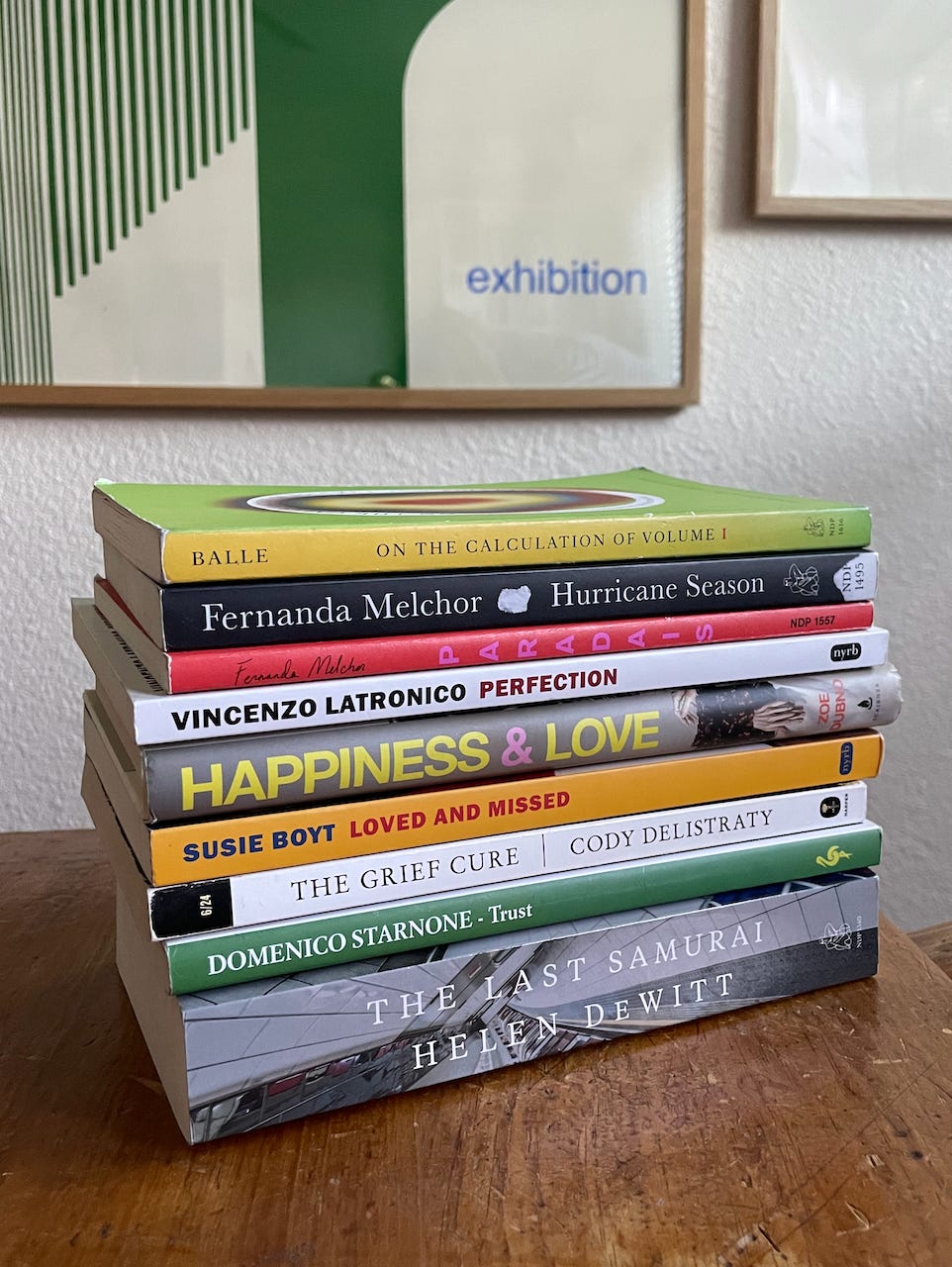
I’ve noticed—and maybe you have too—a somewhat recent wave of contemporary novels that openly build themselves around an older classic, using the earlier work as a kind of structural guide or “north star” text. Two examples of this phenomenon, both of which I’ve devoured with great pleasure: Zoe Dubno’s Happiness and Love, a scathing and very funny sendup of the New York art world written in a single unbroken paragraph, and Vincenzo Latronico’s Perfection, a chilling portrait of millennial materialism and the hollow performance of online taste. These authors’ “north star” texts, respectively, are Thomas Bernhard’s Woodcutters (1984) and Georges Perec’s Things: A Story of the Sixties (1965)—both of which I’m now eager to read, the latter in its original French.
Though I love the occasional doorstopper tome, especially during the summer months, there will always be something endlessly appealing to me about a slim, elegant novel that foregrounds prose and form over plot. Equally satisfying is the fact that these slip easily into my bag and can be carried anywhere. Not long ago, I had such an emotional experience reading Susie Boyt’s Loved and Missed—a wry, tender, devastating, under-200-page novel about addiction, motherhood, generational trauma, and the redemptive possibilities of care—that I suspect coffee shop onlookers may have been concerned for my sanity. Reader, I quite literally laughed and cried. This one was originally recommended to me by none other than Miranda July when I interviewed her for W Magazine a few years back. Miranda knows. Fun fact: Boyt happens to be one of Lucian Freud’s 14 “acknowledged” children (another of which is the fashion designer Bella Freud, who hosts of one of my favorite podcasts, Fashion Neurosis with Bella Freud.
On the topic of slim novels with aesthetically pleasing covers (I know, don’t judge a book by its cover, but I am a magazine editor and judging covers is part of my job), two in translation I’ve adored were Fernanda Melchor’s Paradais—a feverish and propulsive descent into adolescent rage, toxic desire, and class resentment, rendered in hypnotic prose (though if you haven’t yet read Melchor, I’d recommend starting with Hurricane Season; just as heartstoppingly gorgeous and perhaps my favorite of the two)—and Solvej Balle’s meditative On the Calculation of Volume (Book One), in which a bookseller becomes trapped reliving the same November day over and over again. One of the oddest books I’ve read: at times frustrating, undeniably beautiful, deeply philosophical. Definitely of the “no plot, just vibes” variety. (Worth noting that a few very smart reader friends of mine found this one absolutely insufferable. As my late grandfather was fond of saying, “In matters of taste there can be no dispute”).
Currently on my nightstand and enjoying very much: Helen DeWitt’s The Last Samurai (no relation to the 2003 Tom Cruise film of the same name), recommended by my dear friend Cody Delistraty, a supremely talented writer and editor who has never once steered me wrong when it comes to reading material (I highly recommend his first book, The Grief Cure: Looking for the End of Loss), and Domenico Starnone’s Trust. And because I am a millennial woman in the year 2026, I did, like everyone else, make my way down the Strangers to Famesick to Yesteryear pipeline. Read each in less than three days, and have been gobbling up the surrounding discourse almost as voraciously.
WATCHING

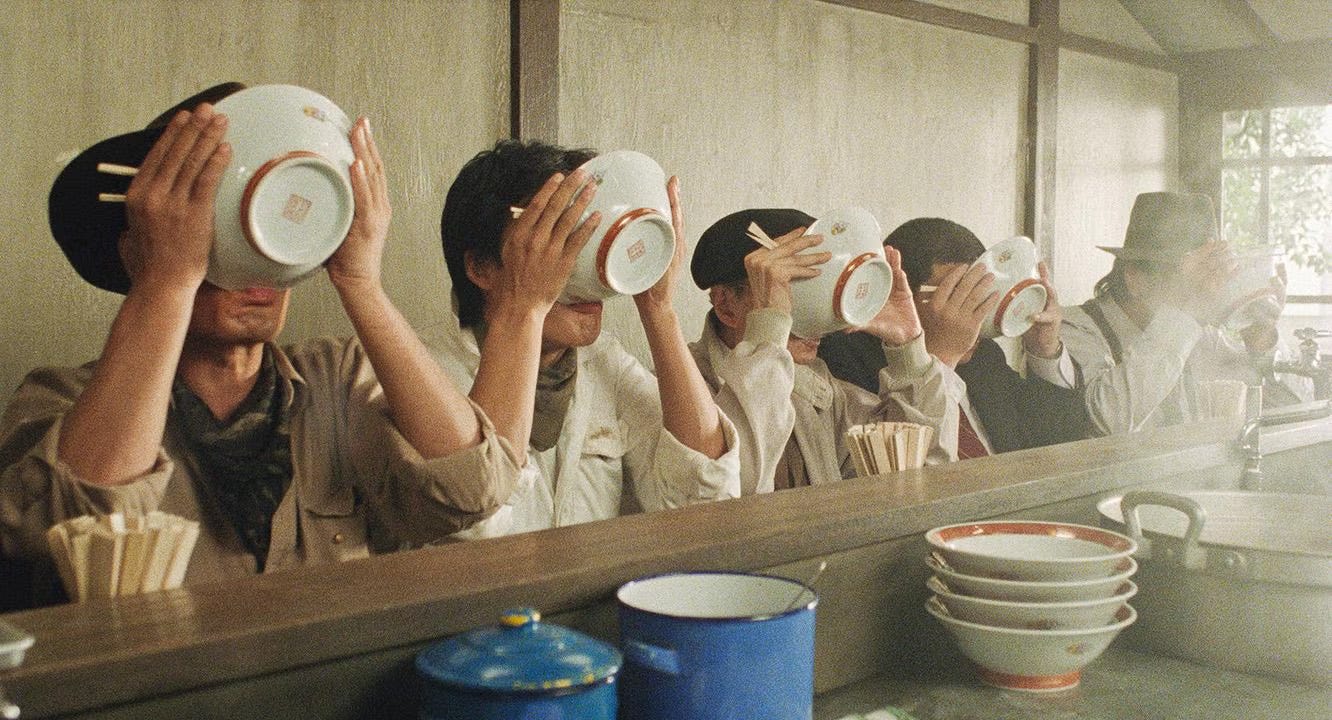
Between recently joining Letterboxd (late to the party, I know) and a friend hosting weekly Sunday movie nights in his garage-turned-twenty-seat-cinema, I’ve been making steady headway on my ever-expanding list of films to watch. In a fit of yearning for a trip to Japan (still at the top of my bucket list), I watched Juzo Itami’s “noodle western” Tampopo (1985) for the first time and understood why so many people speak about it with a fervor that can only be described as religious. I found it utterly enchanting. Funny, sensual, heartwarming. There is a scene during which two characters carefully transfer a raw egg yolk back and forth between their mouths that I… won't soon forget. Caveat: it will make you hungry. Not that scene, at all. But the movie in general.
On the topic of food movies, Laura Gabbert’s 2015 documentary City of Gold, about the late (and dearly beloved) L.A. food critic Jonathan Gold, is pure magic. The film follows Gold as he eats his way through strip malls, taco stands, and tiny hole-in-the-wall restaurants across Los Angeles. A profoundly moving love letter to this city’s rich and varied cultural fabric, to the depth and diversity that so many overlook.
Another urban docu-portrait I enjoyed very much was The Cruise (1998), Bennett Miller’s strange, somewhat mesmerizing stream-of-consciousness film about a highly eccentric New York City bus tour guide named Timothy “Speed” Levitch. Filmed entirely in black and white and absent any voiceover narration, it’s by turns manic and tender (and just might restore your faith in humanity). There’s a delicious dose of ‘90s New York nostalgia here, too. One scene during which the Twin Towers loom overhead is particularly resonant.
As a lifelong Francophile, I’m a sucker for French cinema (the nerd in me also loves that I am technically “studying” while watching). I’ve been a fan of Jacques Audiard’s ever since seeing his glorious Un prophète in theaters when it came out in 2009, after which I made my way through the rest of his filmography. My novelist and cookbook author friend Sanaë Lemoine (whose novel The Margot Affair is another favorite) has impeccable taste in books, films, and food, and shared her French film recommendations with me a while back. On that list was Audiard’s Les Olympiades (2021), a stunning portrait of young Parisians fumbling haltingly toward intimacy amidst the detached landscape of app-era romance, also shot entirely in black and white. Sexy, gutting, gorgeously shot and acted, with an electronic score by Rone that simply destroys me.
Lastly, how had I never seen Robert Altman’s The Player (1992)? (3 Women, from 1977, is a forever favorite). A young Tim Robbins is at his best in this savage Hollywood satire about a studio executive spiraling after receiving death threats from a rejected screenwriter. Vicious and hilarious in equal measure. I had a great time. And I now need to go to Two Bunch Palms, which has a fun cameo here, stat.
WEARING
I recently mentioned to J (who is perhaps Meals Chef Pants’ greatest fan) that I’ve never seen him wear jeans, to which he replied, without hesitation, “Name something less comfortable!” Though my many pairs of vintage Levi’s 501s are on constant rotation, I’ve been taking a page out of his comfort-first book and wearing Deiji Studios’ Loop Pant on repeat for at least the past few months. It’s beginning to be somewhat embarrassing. But I stand by my choice. These are lightweight, ridiculously comfortable, understated yet chic, easily dressed up or down, packable, perfect for petites (at 5’3", nearly every pair of pants I acquire is subject either to my tailor or my scissors, but here, miraculously, no hemming was necessary). I have now worn these while working from home, traveling by car and airplane, running errands, moderating a panel on design, attending art openings and press previews, and more. So far, they seem capable of almost anything. The Ease Trouser, which comes in a range of colors, prints, and fabrications, is also great. And on cooler days, I love the Square Pocket Pant, in a thicker cotton canvas.
Footwear has been a great love of my life for as long as I can remember—my mother likes to remind me that my first-ever word was “shoe.” Repetto Zizi Oxfords, Belgian Shoes Midinettes, and Superga Cotu Classics are just a few styles I imagine I’ll never be without. I have my eye on a pair of Bode House Shoes that will hopefully someday make their way into my closet. Which brings me to one of the simplest and most affordable pair of shoes I own. Plasticana recycled hemp jelly sandals are admittedly nothing new, but over the past few years they’ve become a trusty wardrobe staple. When temperatures drop I swap in the clog version (whose typical wearer is perfectly parodied here). My friend M pairs hers with Japanese shearling inserts for extra coziness, which I have yet to try, but sounds delightful. These shoes have not become ubiquitous for no reason: they are comfortable, understated, and weirdly easy to wear (they go with pretty much everything). Long live “gummy shoes,” as M calls them.
When it comes to jewelry, I’m partial to the kind you can sleep, shower, and swim in. I prefer gold to silver, and rarely take my signet rings or Catbird neck chains off (case in point: have been wearing my high school class ring since 2008; my right-hand ring finger has atrophied accordingly). Interestingly, I am very into seed pearls these days—apart from cleaning, I haven’t removed my Loren Stewart pearl safety pin earring, which my friend S once jokingly described as “avant-WASP,” since purchasing it two years ago. In the warmer months, I also love a seed pearl anklet—a proclivity picked up during my erstwhile days as a copywriter for a fashion brand that used these often in their spring and summer styling. I’ve been wearing this Beatrice Valenzuela version for years (though lovely, it is quite delicate; I’ve now broken and had mine repaired thrice)—but a range of more affordable dupes can be found on Etsy.
ON THE TABLE
The acid queen in me (no, not that kind) craves a squeeze of citrus on just about everything edible. I have been known to panic when running low on lemons. Enter this recipe for Greek lemon potatoes, which J and I have been making nonstop since we discovered it a few months ago. They are tender and bright and alarmingly addictive, especially when made with J’s homemade chicken stock, which riffs on tori paitan. Best paired with slow-roasted salmon or chicken thighs.
A few handy tips from chef friends that have taken my already very good salads to the next level: chill salad bowls in the freezer until just before serving (keeps everything crisp and icy cold); season the lettuce with a pinch of kosher salt before dressing (for a flavor boost); blitz homemade dressing with an immersion blender (for maximum creaminess); add whatever leftover herbs you have to said immersion blender (for an instant Green Goddess effect). A few more from yours truly: lots of tender herbs and shaved fennel make any salad better; radicchio is my best friend (the real ones know); and finally, my go-to dressing is a “lazy Caesar” (somewhat inspired by Gjelina’s lemon-anchovy dressing) made with a single grated garlic clove, 3–4 anchovies, the juice of half a lemon, good olive oil, salt and pepper to taste, and a generous dose of microplaned Parmigiano Reggiano. I prepare this either with a marble mortar and pestle or in a wide-mouthed jar with an immersion blender, depending on what texture I’m after.
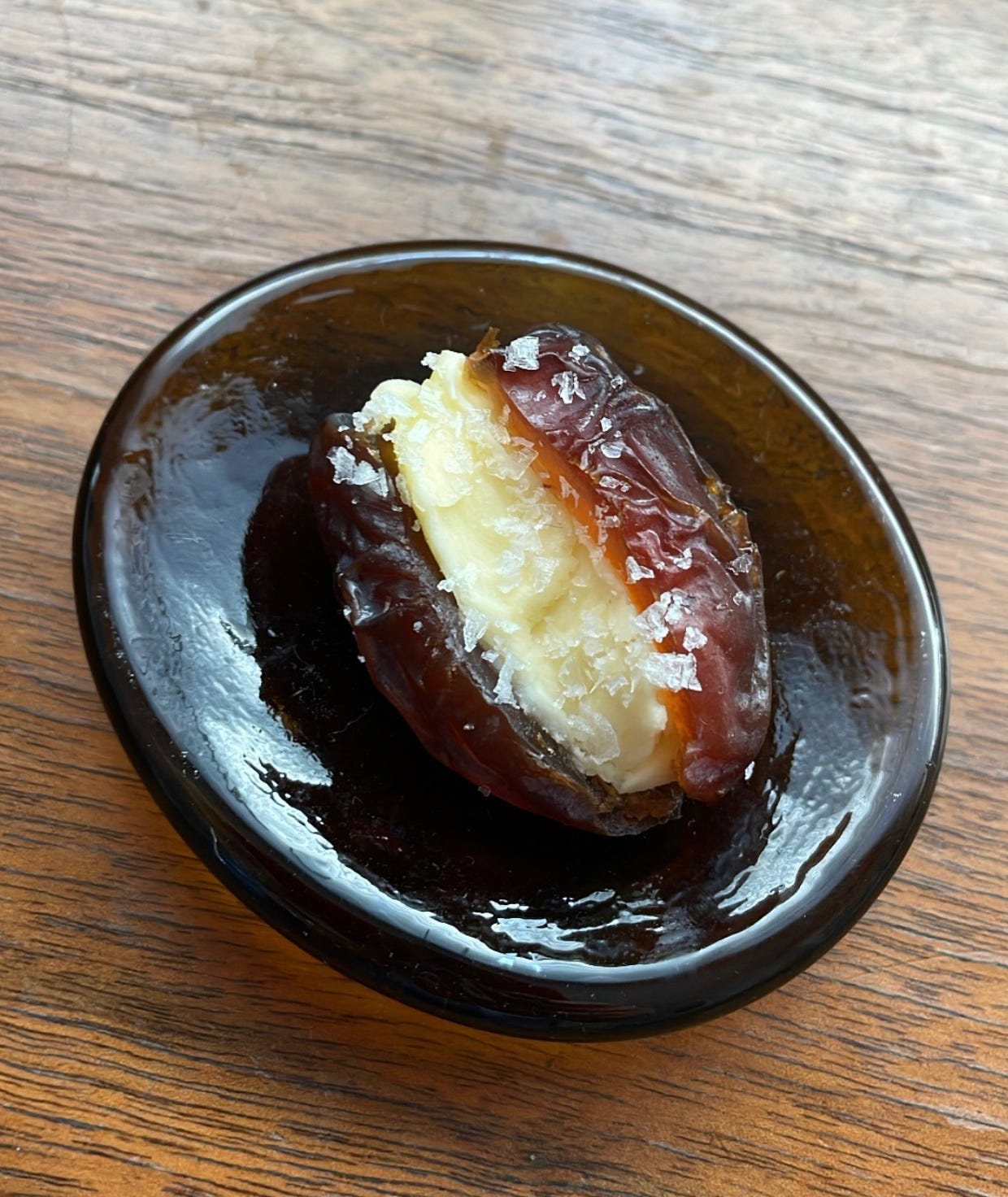
Lastly. We need to talk about butter-stuffed dates, which may be the weirdest and most delicious snack I’ve had in quite a while. Apparently this is trending among biohackers—the fat in the butter supposedly balances the blood sugar spike from the dates—but despite that, I am fully on board. Split open a Medjool date (best if kept cold in the fridge, IMO), tuck in a generous pat of good cultured butter (unsalted Beurre Bordier if you can find it; Rodolphe Le Meunier Beurre de Barratte also excellent), finish with flaky sea salt (I like Maldon or Jacobsen, a tiny tin of which currently lives in my purse for non-art emergencies). A little cinnamon does not hurt. Ideal afternoon-slump fare, and almost eerily reminiscent of cookie dough.
That’s all for now. Thanks for being here.
x A
consider me influenced! Adding Les Olympiades to my watch list and both extremely curious about and stunned by the idea of butter stuffed dates