

The Way Back
On returning to writing after a long hiatus.

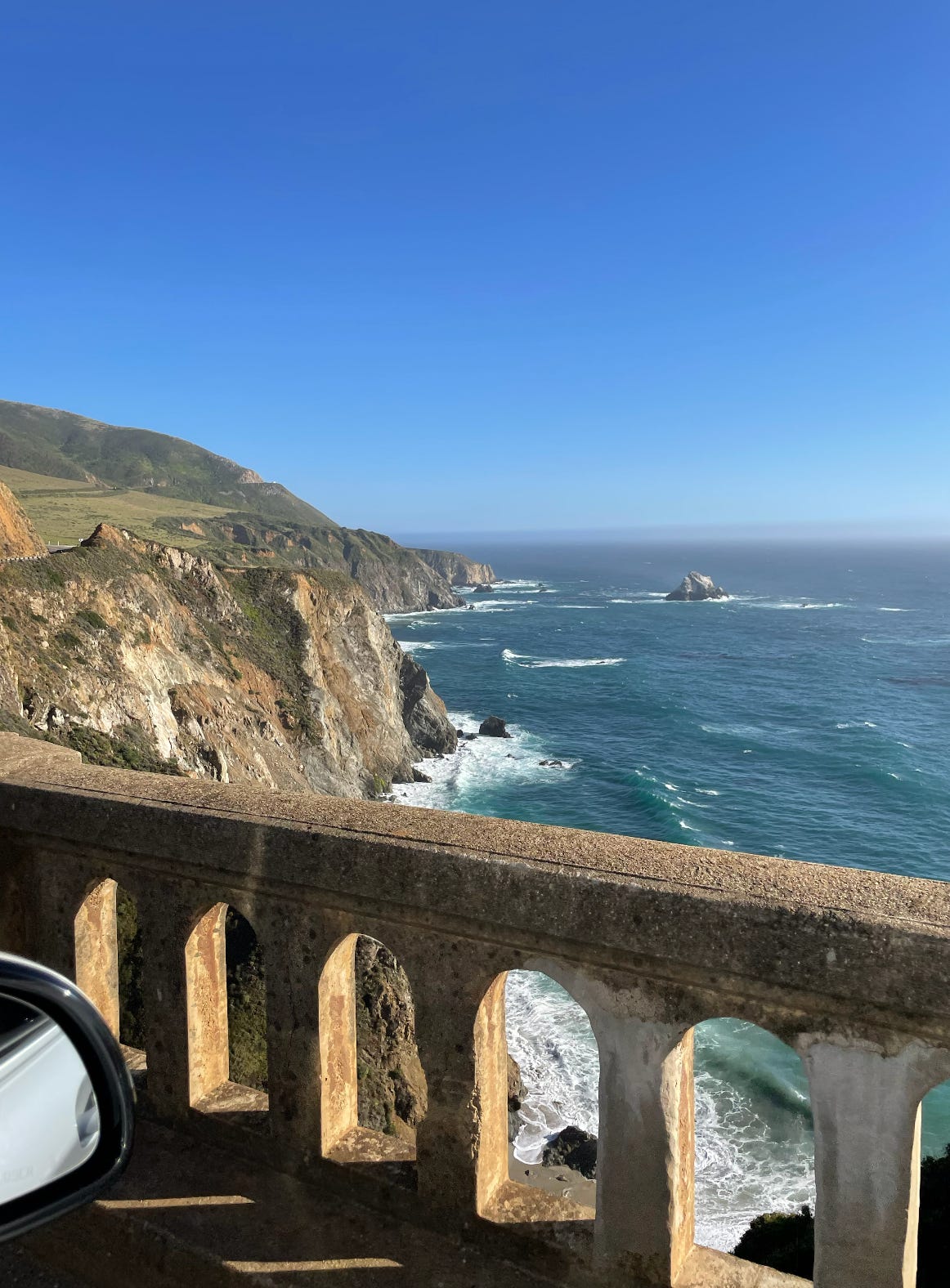
As we wound our way down Highway One, jagged miles of coastline ribboning out around us, a knot formed in my stomach. I’d been looking forward to this trip for weeks, and I was terrified. I had come to Big Sur to write. More specifically, to get back to work on the book I’d been avoiding—had not seen a way back into—for nearly a year. Now I was here, and I had no excuse.
Traveling somewhere just for myself—not for work or a wedding or a bachelorette weekend, not to attend a workshop or conference, not even to visit anyone in particular—was an electrifying concept. It felt almost taboo. Was I allowed to do this? In fact, I was. We’d just turned in the summer issue of the magazine I edit to our printers, and after a month that had been grueling on many levels, I’d resolved to take advantage of the rare lull. Heading to New York to visit friends was tempting, but proved out of the question for both my wallet and my nervous system. My dear friend M was traveling abroad and had generously offered me a week in her Mickey Muennig-designed cabin overlooking the Pacific. Without hesitation, I accepted.
I had fallen madly in love with Big Sur—and with that house—the first time I visited M there, over ten years ago, not least because it reminded me of a heightened, wilder, more remote version of where I grew up (Las Flores Canyon, in Malibu). Throughout my life, that canyon has remained the place on earth where I’ve felt both safest and most imperiled. I sense the same paradox in Big Sur, with its stomach-dropping cliffs, its unwieldy mountain roads, its redwoods still bearing char marks from the 2013 Pfeiffer Fire. The land holds a similar magic, a similar volatility, a sort of power laced with fragility. You feel close to the elements there, utterly at their mercy. Gazing up at a star-stippled sky, traversing a vertiginous ridge, watching the hungry tide slap like cymbals against Keyhole Rock (even amongst hordes of tourists gaping dumbly from the shore, iPhones aloft), your smallness becomes apparent in a way that can only be described as ecstatic. Muennig's approach to architecture, too, has always thrilled me. His structures feel almost as if they’ve grown organically from their surrounding environs, the boundaries between indoors and outdoors porous. His work reminds me somewhat of the house I grew up in, which burned down in last year’s Palisades Fire—a ‘70s hunting cabin with high vaulted wood ceilings and a river rock fireplace, arched doorways, skylights galore, a sweeping view of the Santa Monica Mountains and the ocean beyond them.
It felt right to go there, to the place that so viscerally recalled the home I’d lost, to face what I was writing about that home.
I’d been yearning for a stretch of uninterrupted time, that elusive holy grail for any writer, for so long. I’d toggled between waking up at 5am to write before work on weekdays (utter hell for me personally, though my respect for friends who manage to do this runs deep—looking at you, Andrea Gale) and devoting entire weekend days to writing (my preference, though it does cut into social commitments, and spending seven days on a computer is hard on the body)—but my schedule was often unpredictable, and nothing had really stuck with any consistency. I finally had the stretch of time I’d been craving, and like clockwork, fear flooded in.
What was I afraid of? That I’d lost my touch. That I’d spent too long away from the project to find my way back into it. That I would somehow waste this time, wouldn’t be productive enough. That I had built up an unrealistic fantasy of “uninterrupted time,” that it wouldn’t live up to my expectations. That the structural framework I’d so carefully mapped out in a brand-new notebook wouldn’t work at all once put into practice. Most of all, that the book I’d spent so many years on wasn’t worth writing in the first place.
On the drive up, I’d been anxious and irritable. Hot, cold, hungry, restless, vaguely nauseous. I’d recently gone through a breakup, had invited my mother on the trip in lieu of my ex, and everything she said grated on my nerves. Even as it happened I could see my sharpness for what it was: a reaction to what my body perceived as a loss of control. It wasn’t just fear that I felt—in addition to the breakup, the month of May had brought a work crisis, a series of unexpected car and dental expenses, and a serious health scare for our family dog, Leo. I felt depleted, wrung out like a wet towel. I hoped this week away would revive me.
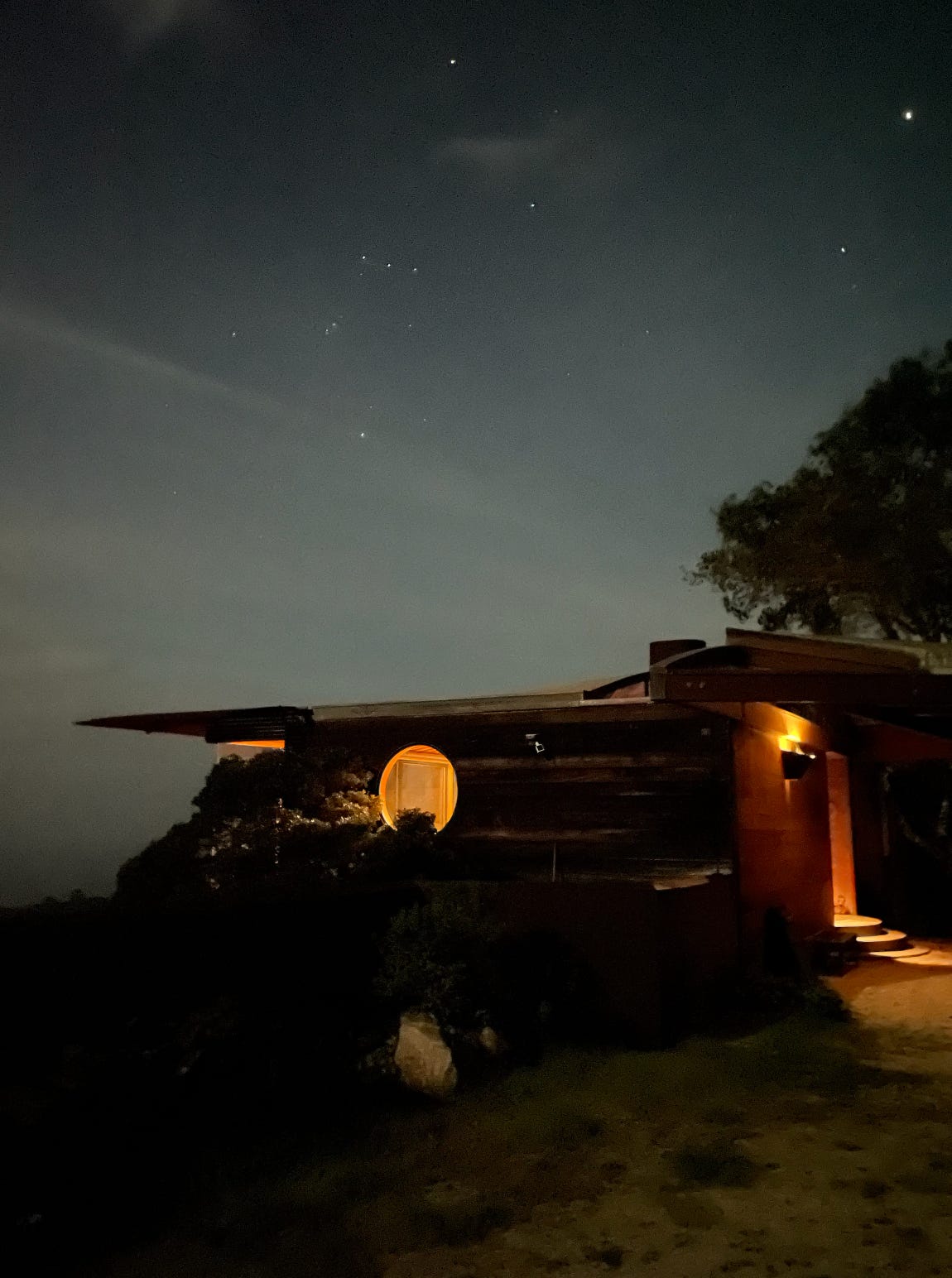
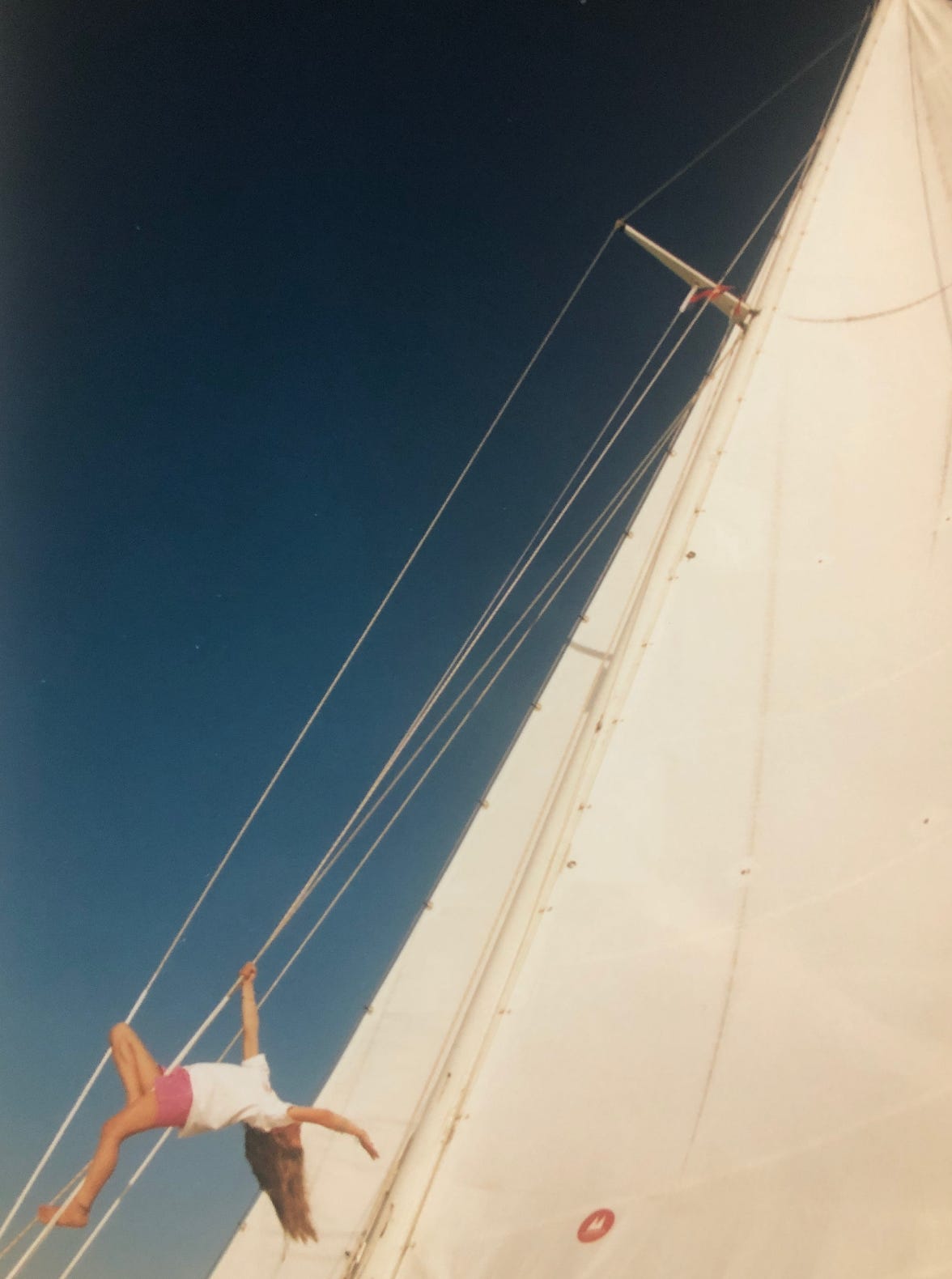
We arrived at dusk. Leo bounded happily out of the car, raced to sniff everything in sight. The house was warm with trapped heat, sunlight having flooded in through glass all day long, which did not help my irritability, but we pushed doors and windows open, unloaded our groceries for the week from Elroy’s (a perfect natural market in Monterey; no notes), the loaf of seaside sourdough from Ad Astra (perhaps the best I have ever had? I cannot resist giving food recommendations, even in a mini-essay that is ostensibly about something else entirely). We uncorked a bottle of cold white wine and got to work in the kitchen: pesto pasta (we as a family have long been loyal to Marcella Hazan’s recipe), chicory salad, crispy roasted broccolini. Cooking with my mother is soothing, nostalgic. It reminds me of our time living together just after my father’s death, and again during the pandemic—but also of the eighteen summers we spent living on a sailboat in France, during which I spent my days reading, drawing, writing, swimming in the ocean, climbing the mast (see photo evidence below), and cooking with my parents. What I wouldn’t give! I had very little understanding of just how rare and special those summers were until they were gone, my father brain injured and no longer able to walk, much less sail. A light breeze made its way through the screen door, poppies flickering on the hillside, and fog began to spill through the canyon below, and for the first time all day, I felt my nervous system begin to settle.
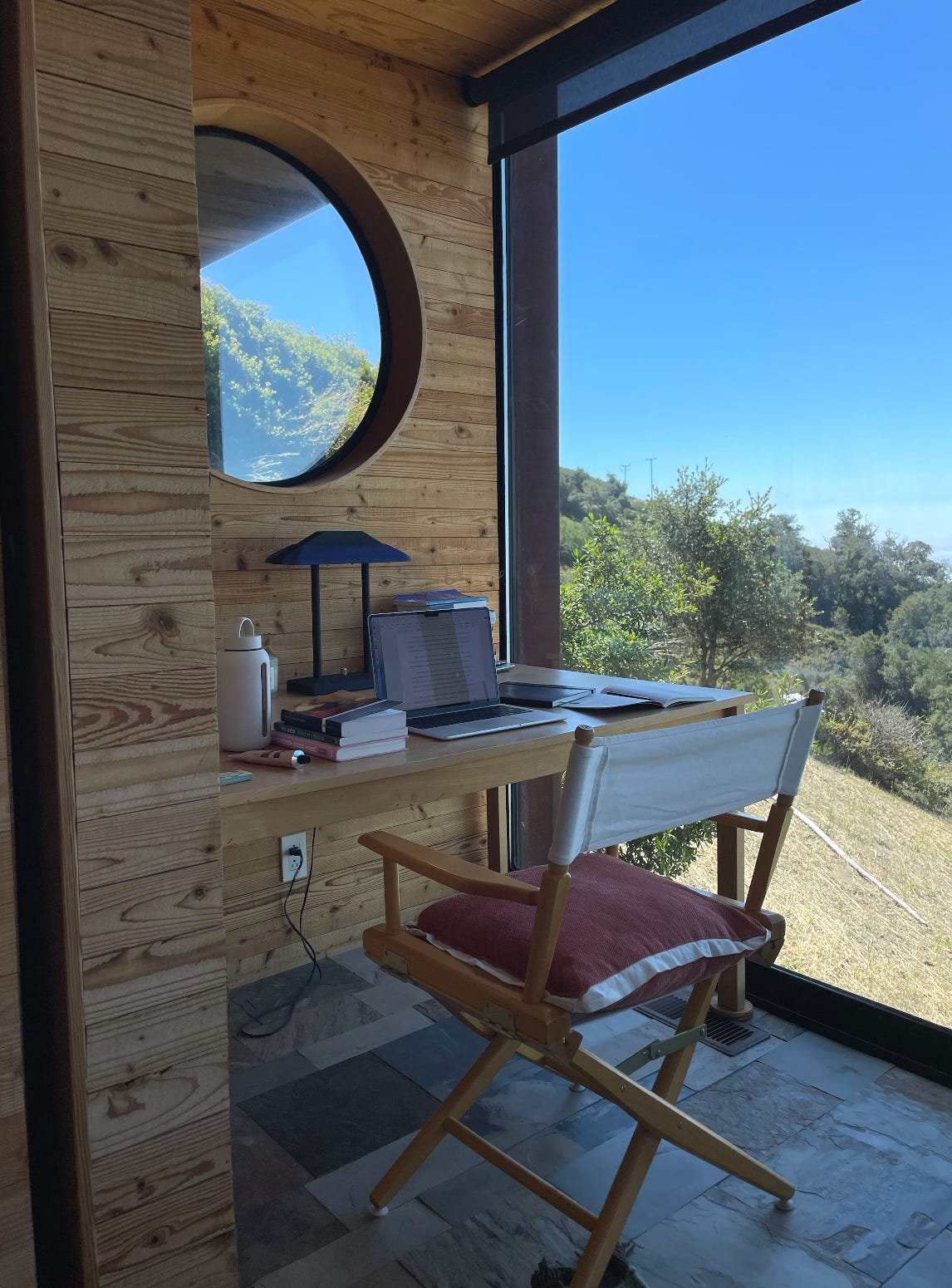
In the morning, heart hammering, I opened two Microsoft Word documents. One was the most recent full draft of the book, which I’d barely touched since the Palisades Fire, the subject matter newly unbearable. The other was blank. Into the blank document I typed my working title, which has remained the same since the beginning; then the James Salter epigraph that has somehow also stuck, becoming only more potent. I reviewed the structure I’d mapped out in my new notebook. It seemed so straightforward, honestly; so obvious. Why hadn’t I thought to write the book this way from the beginning? I reminded myself: If you could have at the time, you would have. I felt bolstered by the fact that in the next room, my mother was writing, too. Like me, she was returning to a project that grief had interrupted. We were in this together.
I started working on the book—if you could even have called it that, then—in 2017. What came out at first were halting fragments. I was twenty-seven and had never written anything longer than a twenty-five-page short story. Over time, the fragments began to lengthen into chapters, and a narrative arc began to emerge, and by May 2020, I had my first full draft. In October of that same year, having moved back into my childhood home in Malibu mid-pandemic, during the worst fire season in California history, I signed with my first literary agent. In early 2021, following a series of traumatic events (the worst of which was a fire at our neighbor’s that nearly took our house down with it; waking at 3am to a wall of flame outside my bedroom window) intensified by the isolation of the pandemic, I had a mental breakdown (more on that someday soon), during which time I did not write for months. After surging out of that difficult period, grateful to be alive—an experience that I often describe to friends as some version of rocketing towards the surface after being trapped underwater, taking great gulps of air—I was near manic. I cut hundreds of pages from the first draft, wrote hundreds more. We shopped the book to editors in the fall of 2022. Despite considerable enthusiasm, I was met with twenty-two rejections.
My agent had emailed me each editor’s comments. I read them on my phone while parked outside of an outdoor screening of the ‘90s cult classic The Craft, which I had attended with two friends, all of us decked out in full teenage-witch costume. Then I drove back to Malibu along PCH, ugly-sobbing in goth makeup. Passing Topanga, I pulled into a gas station to fill up, caught my reflection in a window, laughed at the absurdity of it all—how I must have looked to strangers. Editors had praised my prose as evocative, elegant, haunting, stylish, atmospheric, transportive, lyrical, emotionally rich, exquisitely observed—but overall, it seemed, no one could quite figure out how to position the book I’d written. Some wanted a stronger narrative arc; others wanted a bigger hook; still others wished for more overt focus on the climate crisis (this last one somewhat of a head-scratcher, but I suppose my title had given them the wrong idea). Almost uniformly, they worried that memoir was a difficult market; that a meditative, literary book about family, grief, and mental illness would be difficult to break out in an increasingly crowded market. Again and again, I read some version of the same sentence: beautiful writing, but I wouldn’t know how to publish it.
This was normal, my agent insisted. Did I know how many writers had received thirty, forty, even fifty rejections before that one yes? You only needed one, it was true. We would keep submitting, she said, and someone would buy it eventually—she was sure of this. Alternatively, she wondered, would I be open to reworking it as a novel for the two editors who had offered to reread a fictional version? And if so, could I turn in a new opening chapter by the end of the month? I spent a few weeks simmering on all this. If I was honest with myself, my agent had never quite felt like a match—I hadn’t felt seen or understood by her in the way I’d hoped to—but more importantly, I knew somewhere in my bones that the book was not yet ready. It needed more time, more distance, more perspective. I pulled it from submission and left her, reeling.
I know now how common the general arc of this story is, though few writers talk openly about it. The first book one completes is rarely the first one published. Start asking around and you’ll learn the same. At the time, though, it was devastating: all those years spent nurturing a project, believing in it, making sacrifice after sacrifice for it, only to watch the future I’d imagined for it evaporate.
Memoir is just too tough right now. Nearly every editor had written some version of this sentence. A few had added in: But I’d love to read her fiction!
I have never cared much for “genre” as a concept. I’ve always appreciated the French attitude towards it: how the novels of Annie Ernaux and Marguerite Duras and Édouard Louis and Emmanuel Carrère often carry the emotional weight of memoir while still enjoying the freedom (and cultural prestige, for that matter) of fiction. The American publishing industry, however, is far more invested in these distinctions. I studied fiction during my MFA and had never considered myself to be a memoirist, but by the time I'd finished a draft of my book, it was difficult to argue that what I'd written wasn't memoir, at least from an American standpoint. Even so, I resented the pressure to categorize it. Why did I have to instruct readers on how to approach the book before they'd even opened it? Why did it matter whether every event had happened exactly as written if the deeper emotional truth remained the same? And wasn’t memoir, at its core, just another form of fiction—shaped as it was by its narrator’s unique lens and biases?
I did not write for nearly a full year after pulling the book from submission. This was not a conscious choice. I had promised myself that I would get back on the horse, would not let this setback break me. Still, I was shattered. I didn’t feel ready or able to write, despite desperately wanting to. I took some time off, focused on the less personal forms of writing through which I’d built my career (arts & culture journalism, copywriting), nursed my wounds, began to build my confidence back up. At a certain point I began to feel it again—that particular itch to return to the book. I cracked open the manuscript, gingerly at first, and began to revise it. I killed darlings, restructured entire sections, cut what felt like every last ounce of excess. I sent the new draft to a handful of writer friends, incorporated their insightful notes, revised once more. But something still wasn’t right. I couldn’t put my finger on what, exactly. After taking a bit more time off, I started over again, this time reworking the book as a novel. A rush of excitement, then: fiction, it seemed, gave me the freedom to preserve what mattered most emotionally while tweaking the details to best serve the story. It also simplified the complex timeline I’d been wrestling with. Why had I been so resistant to this at first, when my agent had suggested it? If you could have at the time, you would have. I made my way through about a third of that new fictionalized draft. Then the Palisades Fire happened, and I lost my childhood home—a place that functioned as the beating heart of the book I’d written. The boundary between art and life collapsed. I couldn't bring myself to open the document again for nearly a year. When I finally did, I realized with a pit in my stomach that I'd started the story in the wrong place. I could finally see the present-day thread that needed to anchor the book. It was exactly the thread I'd spent years trying not to foreground. Of course it was.
That was where the book stood when I arrived in Big Sur. I hoped the path I'd found would hold. I'd lost so much over the past several years: my father, my childhood home, a fifteen-year friendship, more imagined futures than I cared to count. I wasn't sure I had another heartbreak in me.
Working on the new draft was uncomfortable at first. I kept finding excuses to get up, make a snack, brew a pot of tea, check my phone. This is stupid, I thought. Maybe I’m not cut out for it. I wanted to run away. I wanted to do anything besides sit in front of that laptop. We were in Big Sur, for crying out loud—shouldn’t we be outside? I pushed these thoughts away as best I could, forced myself to sit there. To open my eyes and look, to face what I’d come here to do. And slowly, slowly, it came back. The thing I thought I’d lost. The writing began to flow.
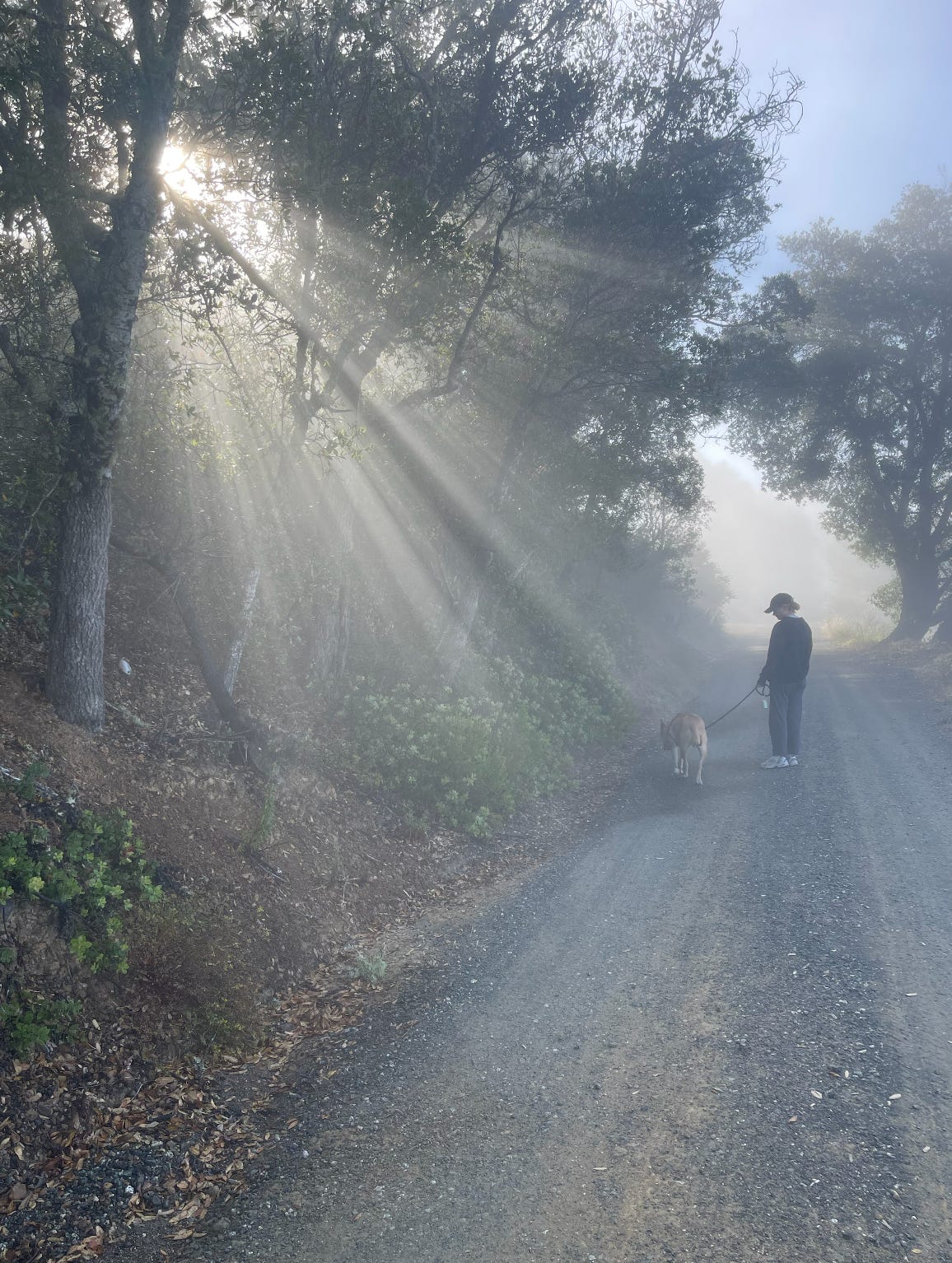
In Big Sur, my mother and I started each morning with a walk through the mountains, Leo trotting between us, just like we’d done back home in Las Flores Canyon when I lived with her during the pandemic. We wrote and read by day, cooked and talked by night. Red-tailed hawks soared overhead. I felt newly energized by what I was writing, in near disbelief at how it was suddenly surging out of me. I understood, finally, that I couldn’t have gotten here any other way, that there hadn’t been some shortcut I’d missed. Every version of the book had been necessary, and I couldn’t have written this version earlier. I hadn’t yet been ready to face the story that needed to be told. Now I was. Now I am. That’s not to say that there won’t be days when I get stuck and want to tear my hair out; that I won’t doubt myself repeatedly throughout the “overwhelming, all-consuming forced march” (as Emma Cline so aptly put it when I interviewed her for The Paris Review Daily in 2020) that is novel-writing. Those things are a given. With a demanding full-time job that often requires weekend work and an active social life (rare extroverted writer here), I’m still sorting out the consistency piece of my practice, finding a schedule that works for me when I can’t spend a week off emails and Slack in Big Sur. But something is different this time around. I have the distance, wisdom, perspective, and toughened hide I lacked before. I am becoming the version of myself that I’ve needed to be to write this story.
I really appreciate this honesty. I have felt disconnected from myself as a writer since leaving LA and moving back home, and some days I fear it’s gone away for good, but this gives me hope. Beautiful piece can’t wait to read your book
Beautiful. Looking forward to reading your book one day!